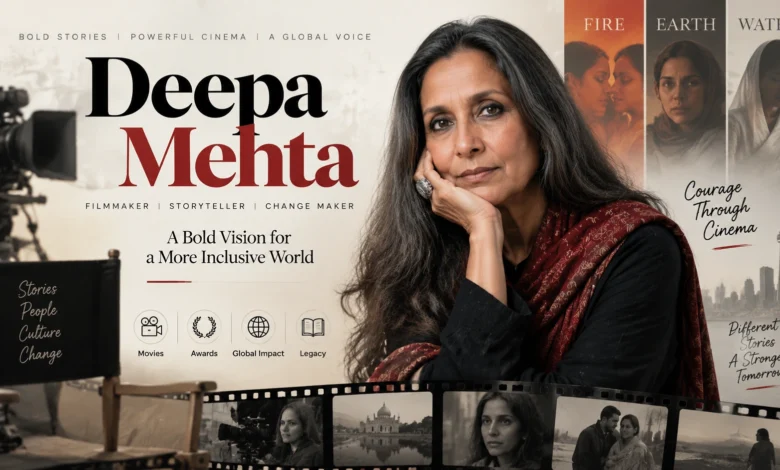
Few directors have managed to build a career the way Deepa Mehta has: rooted in one culture, shaped by another, and never quite comfortable staying inside the lines either one drew for her. For nearly five decades, she has made films that Indian audiences have protested in the streets and that Canadian institutions have honoured with their highest awards, sometimes for the very same film. That tension is exactly why she matters. Few filmmakers occupy the space between two national cinemas as fully as she does, and fewer still have used that position to keep asking uncomfortable questions about gender, faith, and belonging.
This article traces her path from a childhood in Amritsar to her emergence as one of Canada’s most decorated directors. It looks closely at the Elements Trilogy that defined her international reputation, the other major films that rounded out her body of work, the recurring ideas that tie her filmography together, and the awards that have followed her career at nearly every stage. By the end, readers should understand not just what Deepa Mehta has made, but why her films continue to matter to conversations about world cinema.
Who Is Deepa Mehta?
Deepa Mehta is an Indian-born Canadian film director, screenwriter, and producer whose work sits at the intersection of South Asian storytelling and Canadian independent cinema. She writes many of her own screenplays, often producing her films through Hamilton-Mehta Productions, the company she co-founded with her husband and longtime producing partner, David Hamilton. That level of creative control has allowed her to maintain a consistent authorial voice across a body of work that spans drama, adaptation, and documentary.
She is best recognised internationally for the Elements Trilogy, three films unified by title rather than plot, each named for a natural element and each confronting a different fracture in South Asian social life. But reducing her career to that trilogy undersells the range of what she has done. She has adapted a Booker Prize-winning novel, directed a crime drama set inside Vancouver’s Indo-Canadian gang scene, and told a coming-of-age story set against the backdrop of Sri Lanka’s civil war. Across all of it, she has remained a filmmaker willing to court controversy rather than avoid it, which is part of what has made her career so closely watched.
Deepa Mehta’s Early Life and Path Into Filmmaking
Deepa Mehta was born in Amritsar, Punjab, in 1950, into a family connected to the film business through her father’s work as a movie distributor. That early exposure meant she grew up around cinema in a practical sense long before she considered making films herself; she has described watching prints arrive and screenings being arranged as simply part of daily life. Her family later moved to Delhi, where she completed much of her schooling before going on to study philosophy at the University of New Delhi, a background that shows up in the more contemplative, morally probing tone of her later work.
Her formal entry into filmmaking came through documentaries rather than fiction. After relocating to Canada, she began working on documentary shorts, gaining experience in the discipline of nonfiction storytelling before moving into narrative features. That documentary grounding is often cited as one reason her fiction films feel so textured and observational, particularly in how she frames domestic spaces and everyday social rituals. Her first narrative feature, made in the late 1980s, was a modest beginning compared to what followed, but it marked the start of a directing career that would eventually put her at the centre of some of the most debated films to come out of either Canadian or Indian cinema. Readers interested in creative careers in the entertainment industry can also explore how other public figures have built their professional journeys.
The Elements Trilogy: Fire, Earth, and Water
Fire, released in 1996, is widely regarded as the film that put Deepa Mehta on the international map, and it did so through controversy as much as critical acclaim. The story follows two sisters-in-law in a joint Hindu family in Delhi who form a romantic relationship with each other, a plot that directly challenged assumptions about arranged marriage, women’s autonomy, and same-sex desire within a conservative household structure. The film was met with organised protests in India, including vandalism at cinemas showing it, yet it was ultimately released uncut and went on to screen at major festivals internationally, opening the door for the two films that would follow it.
Earth, released in 1998 and based on Bapsi Sidhwa’s novel Cracking India, moved the trilogy’s focus from gender to nationhood. Set during the 1947 Partition of British India, the film follows a group of friends from different religious communities whose relationships collapse under the weight of sectarian violence as India and Pakistan are carved into separate states. It captured the personal cost of a historical event usually discussed only in terms of statistics and borders, and it was submitted as India’s official entry for the Academy Award for Best Foreign Language Film. Water, the final film in the trilogy, arrived in 2005 after years of delay caused by protests during its original filming location in Varanasi, and it examined the lives of Hindu widows confined to an ashram under religious tradition in colonial-era India.
Deepa Mehta’s Other Major Films
Beyond the Elements Trilogy, Deepa Mehta has built a filmography that resists easy categorisation. In 2012, she directed Midnight’s Children, an adaptation of Salman Rushdie’s Booker Prize-winning novel, with Rushdie himself contributing to the screenplay and narrating the film. Adapting a novel as structurally ambitious as Midnight’s Children, which follows a generation of Indian children born at the exact moment of the country’s independence, was a significant undertaking, and the film stands as one of the more literary, large-scale projects in her career.
Her other work has continued to push into new territory rather than repeat familiar ground. Beeba Boys, released in 2015, shifted her focus entirely to contemporary Vancouver, following an Indo-Canadian gang leader navigating loyalty, ambition, and violence within the city’s underworld, a sharp departure in tone and setting from her earlier period dramas. Funny Boy, adapted from Shyam Selvadurai’s novel and released in 2020, told a coming-of-age story about a Tamil boy in Sri Lanka discovering his sexuality against the backdrop of the country’s escalating ethnic conflict, and it was later submitted as Canada’s entry for the Academy Award for Best International Feature Film. Taken together with earlier work like Bollywood/Hollywood, a lighter satirical comedy that still engaged with questions of cultural identity within Indo-Canadian families, her filmography shows a director unwilling to settle into a single genre or register, even as certain concerns keep resurfacing.
Themes and Style in Deepa Mehta’s Filmmaking
What ties Deepa Mehta’s films together is less a visual signature than a set of persistent questions. Nearly every one of her major works examines how individuals, particularly women, are constrained by systems larger than themselves: family hierarchy, religious tradition, national borders, or organised crime. Fire interrogates the expectations placed on wives within a joint family; Earth examines how communal identity can override personal loyalty overnight; Water looks at how religious doctrine can be used to justify the abandonment of widows. Even Beeba Boys, on the surface a genre crime film, is ultimately concerned with how young men in immigrant communities are shaped by the expectations and limitations placed on them.
Stylistically, Mehta tends to favour a grounded, observational approach over stylistic flourish, letting performances and social detail carry the emotional weight of a scene rather than relying heavily on camera movement or editing tricks. She often works with strong ensemble casts and collaborates closely with source authors when adapting existing material, as seen in her work with Bapsi Sidhwa and Salman Rushdie. Her willingness to court institutional and public backlash, most visibly with Fire and during the production of Water, has become something of a defining trait in itself; she has rarely softened a film’s central provocation in response to outside pressure, choosing instead to see difficult productions through to completion even when that meant years of delay.
Awards and Recognition
Deepa Mehta’s body of work has been recognised extensively by Canadian film institutions and international award bodies alike. She won a Genie Award, Canada’s national film award at the time, for her screenplay for Bollywood/Hollywood, and her direction across multiple films has earned her nominations and wins within the same circuit over the years. Water’s nomination for the Academy Award for Best Foreign Language Film remains one of the most significant honours of her career, marking one of the rare instances of a Canadian-submitted film reaching that stage of the Oscars in a language other than English or French.
Her recognition extends beyond individual film awards into honours reflecting her overall contribution to the arts. In 2012, she received the Governor General’s Performing Arts Award for Lifetime Artistic Achievement, widely regarded as Canada’s highest honour in the performing arts. She has also been named an Officer of the Order of Canada, specifically cited for challenging cultural traditions and bringing stories of oppression and injustice into public view, along with honours including the Order of Ontario and recognition from film critics’ circles for her direction. Taken together, these honours reflect not just acclaim for individual films but an acknowledgment of a career built around consistently difficult, socially engaged storytelling. Readers interested in successful entertainment careers can also explore how other globally recognised artists have built long-term careers in the industry.
Conclusion
Deepa Mehta’s career has never followed the safest path available to her. She chose subjects that provoked protest before they earned praise, adapted novels that many directors would consider unfilmable, and kept returning to questions about power, faith, and belonging long after each individual controversy had passed. From Amritsar to the international festival circuit, her work has consistently treated South Asian identity as something worth examining honestly rather than presenting for easy consumption.
What lingers most about her filmography is its refusal to soften. Whether the setting is a Delhi household, a Varanasi ashram, or a Vancouver street corner, Deepa Mehta’s films insist that the personal and the political are never really separate, and that insistence is likely to shape how her work is discussed in world cinema for a long time to come.