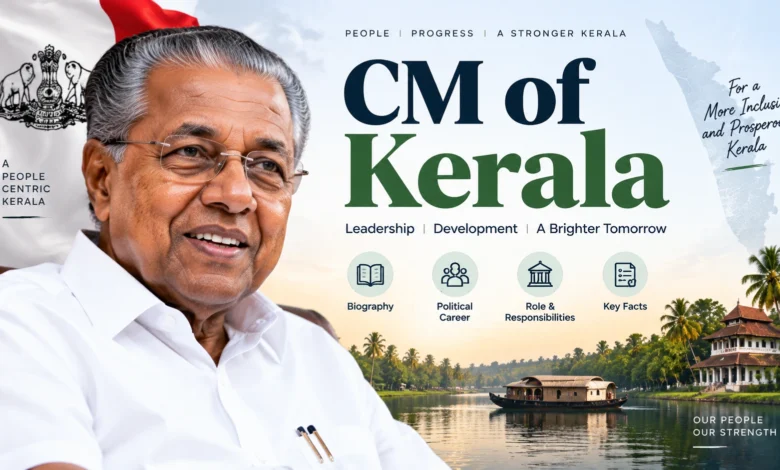
Searches for the current CM of Kerala tend to spike whenever the state features in national headlines, whether that is around a policy announcement, an assembly session, or simply general curiosity about how one of India’s most closely watched states is governed. Kerala has a long tradition of competitive, closely fought elections between two major political fronts, and leadership changes there are followed well beyond the state’s own borders. That is especially true after the 2026 assembly election, which brought a change in government after a decade of continuous rule by the previous administration.
This article explains who currently holds the office of Chief Minister of Kerala, how he arrived there, and what his background looks like heading into the role. It also covers the office’s general responsibilities and offers a brief look at the Chief Ministers who came before him, so readers get both the immediate answer they are searching for and the wider context around it.
Who Is the Current Chief Minister of Kerala?
The current Chief Minister of Kerala is V. D. Satheesan, who took charge of the office in May 2026 following the state assembly election held earlier that year. He leads the government as the head of the United Democratic Front, the coalition anchored by the Indian National Congress, after the alliance secured a decisive majority in the 140-member Kerala Legislative Assembly. His appointment marked the end of a ten-year run in government for the rival Left Democratic Front, making the transition one of the more closely watched state-level power shifts in recent Indian politics.
Before becoming Chief Minister, Satheesan was already a familiar figure in Kerala’s political landscape, having served as Leader of the Opposition in the outgoing assembly. Readers interested in public figures and their career journeys can also explore profiles of other well-known personalities. That role placed him at the center of the Congress-led alliance’s campaign heading into the 2026 election, and his visibility during that period is widely seen as one of the factors behind his eventual selection to lead the new government. As Chief Minister, he now oversees the day-to-day functioning of the state government, working alongside a council of ministers drawn from the various parties that make up the ruling coalition.
V. D. Satheesan’s Background and Early Career
V. D. Satheesan was born in 1964 in Nettoor, Kerala, and his professional path before politics ran through law rather than public administration. He studied at Sacred Heart College in Thevara and later at Rajagiri College of Social Sciences in Kochi, before going on to pursue legal education at the Kerala Law Academy Law College and Government Law College in Thiruvananthapuram. That legal training became the foundation of his early career, during which he practiced as an advocate and built a reputation within Kerala’s legal circles before shifting his focus toward full-time politics. That legal training became the foundation of his early career, during which he practiced as an advocate and built a reputation within Kerala’s legal circles before shifting his focus toward full-time politics. Similar career paths of public personalities often show how professional backgrounds influence later public roles.
His entry into active politics came through the Indian National Congress, the party he has remained associated with throughout his career. Like many Kerala politicians with a legal background, his early public profile combined courtroom experience with student and youth political activity, a common pathway into state politics in Kerala. That combination of legal grounding and party organizational work gave him both the procedural knowledge of governance and the campaign experience that would later shape his long run as an elected representative.
Political Career Before Becoming Chief Minister
Satheesan has represented the Paravur constituency in the Kerala Legislative Assembly since 2001, giving him one of the longer continuous tenures among sitting MLAs in the state by the time of the 2026 election. Over more than two decades in the assembly, he built a reputation as an active legislator known for detailed engagement with financial and administrative matters, which eventually positioned him for senior roles within his party’s state leadership.
His most prominent role before becoming Chief Minister was as Leader of the Opposition in the Kerala Legislative Assembly, a position he held from 2021 until the formation of the new government in 2026. During that period, he served as the primary opposition voice against the previous Left Democratic Front government, a role that significantly raised his public profile ahead of the 2026 campaign. His time as Leader of the Opposition is widely regarded as the immediate stepping stone to his selection as the United Democratic Front’s face for the Chief Minister’s post once the alliance won a majority.
The 2026 Kerala Assembly Election and Transition of Power
The 2026 Kerala Legislative Assembly election was held on April 9, 2026, with results declared on May 4, 2026. The United Democratic Front, led by the Indian National Congress, won a decisive majority, securing 102 of the 140 seats in the assembly, compared to 35 seats for the Left Democratic Front and a handful of seats for other parties. Within the Congress-led alliance, the Indian National Congress itself emerged as the single largest party, giving it the leading voice in deciding who would head the new government.
Following the results, there was a period of internal deliberation within the Congress and the wider alliance over who would be selected as Chief Minister, with more than one senior leader considered for the post before the party’s central leadership confirmed Satheesan as the choice. He was sworn in on May 18, 2026, along with a full council of ministers drawn from the constituent parties of the alliance, formally ending the previous government’s decade in office. The transition was carried out through the standard constitutional process, with the outgoing administration handing over charge once the new ministry was formed and the new Chief Minister assumed office before the Governor.
Role and Responsibilities of the Kerala Chief Minister
The Chief Minister of Kerala functions as the head of the state government and the leader of the majority party or coalition in the Kerala Legislative Assembly. In practical terms, the role involves chairing the council of ministers, coordinating policy across departments, and acting as the primary link between the elected government and the Governor, who serves as the constitutional head of state. The Chief Minister is also responsible for representing Kerala in discussions with the central government on matters ranging from funding allocations to disaster response and infrastructure planning.
Beyond administrative coordination, the office carries significant political weight as the public face of the ruling alliance. The Chief Minister typically holds key portfolios directly, distributes remaining departments among cabinet colleagues, and is accountable to the assembly through mechanisms like question hours and no-confidence motions. Given Kerala’s history of closely contested elections between two major fronts, the office has traditionally required a Chief Minister who can manage coalition politics carefully, since governments in the state are almost always formed by multi-party alliances rather than a single party governing alone.
A Brief Look at Past Chief Ministers of Kerala
Kerala’s list of Chief Ministers stretches back to the state’s formation in 1956, with E. M. S. Namboodiripad becoming its first Chief Minister after leading the Communist Party to an early electoral victory. In the decades since, the office has alternated fairly regularly between leaders aligned with the Left Democratic Front and those aligned with the Congress-led United Democratic Front, reflecting the broadly two-front nature of Kerala’s electoral politics. Figures such as K. Karunakaran, A. K. Antony, and E. K. Nayanar each served multiple terms across different periods, shaping the state’s approach to areas like education, healthcare, and land reform along the way.
More recently, Oommen Chandy led the state as Chief Minister from 2011 to 2016 before Pinarayi Vijayan took office in 2016 and went on to lead two consecutive terms until the 2026 election. Vijayan’s decade in office is often referenced in discussions of Kerala’s recent governance record, covering periods that included major public health responses and infrastructure initiatives. His government’s exit after the 2026 result, and Satheesan’s subsequent appointment, represents the latest instance of the alternating pattern that has defined Kerala’s political history for much of the state’s existence.
Conclusion
Kerala’s leadership changed hands in 2026 when V. D. Satheesan, a longtime MLA from Paravur and the state’s former Leader of the Opposition, was sworn in as Chief Minister after the United Democratic Front’s decisive win in that year’s assembly election. His path to the office reflects a career built over more than two decades in the state legislature, grounded in an earlier background in law before he moved fully into public life. As with any state government, developments in policy, cabinet composition, and political alignment can continue to evolve, so readers looking for the latest updates on Kerala’s leadership and governance should continue to follow trusted, verified news sources for ongoing coverage.


