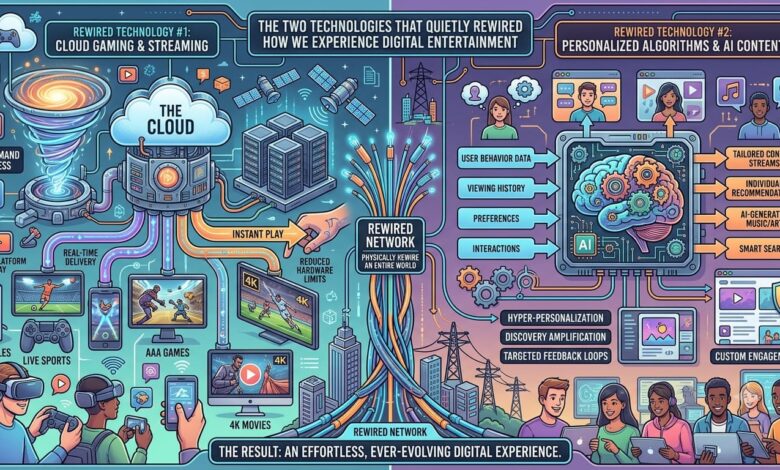
Two technologies share credit for most of what’s changed in digital entertainment over the past fifteen years. Neither was invented for entertainment. Both arrived as infrastructure, unglamorous and largely unannounced. And both, once they reached sufficient maturity, enabled entirely new categories of experience that hadn’t been possible before.
The smartphone and the modern web browser. Neither looks particularly revolutionary at first glance. One is a telephone with additional capabilities. The other is a window for reading documents on the internet. But the smartphone became a supercomputer in a pocket, and the browser became a full application runtime capable of rendering 3D graphics, processing audio in real time, and maintaining persistent network connections for multiplayer experiences. The combination reshaped the economics, the reach, and the design language of digital entertainment more completely than anything before it.
Understanding what actually changed, specifically and concretely, is more useful than celebrating the transformation in the abstract.stay updated with all
What Smartphones Actually Changed About Who Gets to Participate
The entertainment industry has always been constrained by hardware. Films required cinema projectors. Recorded music required record players, then CD players, then MP3 players. Video games required consoles or gaming PCs. Each format reached the audience that could afford and access the hardware, and excluded everyone who couldn’t.
Smartphones changed this arithmetic in a specific way. They didn’t make entertainment hardware free. They made entertainment hardware something hundreds of millions of people already owned for completely unrelated reasons. The device in your pocket for calls and messages became, almost incidentally, a gaming device, a streaming device, and an interactive platform.
The demographic consequence of this is worth pausing on. The gaming audience that grew up on consoles was shaped by who could justify dedicated gaming hardware: predominantly young, predominantly male, concentrated in higher-income markets. The smartphone audience is shaped by who owns a phone, which is substantially everyone. The entertainment categories that have grown most aggressively on mobile in the past decade reflect that democratization in their user demographics, which look nothing like the traditional gaming audience.
The Portability Premium Nobody Calculated in Advance
Portability turned out to produce a behavioral change that was larger than most people anticipated. When entertainment is always with you, you consume more of it. Not because you’re less disciplined, but because the marginal time available for brief entertainment consumption is much larger than the time available for sit-down entertainment consumption. The fifteen minutes between two meetings is not enough to watch an episode of a series. It is enough to play a mobile game, check in on a social platform, or listen to a podcast.
This behavioral shift created demand for entertainment products specifically designed around it. Not just condensed versions of desktop experiences, but formats that are genuinely satisfying in five to fifteen minutes. The explosion of short-form video, casual gaming, and podcast formats across the past decade is substantially a response to that mobile portability premium.
The Browser’s Transformation: From Document Viewer to Application Platform
The web browser in 1995 was a document viewer. Pages loaded, text appeared, images loaded slowly, and that was approximately the full capability. Interactivity meant clicking links. Video was not supported. Audio was barely supported. The idea of running a 3D game in a browser would have been laughable.
The browser in 2024 runs a different class of software entirely. The Canvas API and WebGL enable GPU-accelerated 2D and 3D rendering that can match native application quality for many game genres. The Web Audio API gives developers a full programmatic audio pipeline with spatial processing and low latency. WebSockets maintain persistent bidirectional connections that make real-time multiplayer practical. WebAssembly allows code originally written in C or C++ to execute at near-native speed. Progressive Web App APIs enable installation to home screens, offline functionality, and push notifications.
This transformation happened over roughly two decades of incremental browser improvement, driven by competition between browser vendors and by the ambitions of web developers who kept pushing against the limits of what the platform could do. The result is a runtime capable of delivering the vast majority of entertainment experiences without requiring any installation at all.
The Distribution Dividend That Changed Who Could Reach an Audience
Browser-based delivery produces a distribution advantage that native app delivery doesn’t have. A link is a complete distribution mechanism. Someone shares it, someone else clicks it, the experience begins immediately without any installation. The barrier between a potential user and a first experience is essentially zero.
Compared to native app distribution, which requires the user to visit a store, download, install, grant permissions, and potentially create an account before experiencing anything, this is a different order of magnitude of friction reduction. The conversion rate from ‘heard about this’ to ‘tried this’ is substantially higher when the path is a link rather than a download. For entertainment products where word-of-mouth is the primary discovery mechanism, that conversion rate matters enormously.
Cloud Infrastructure: The Third Technology Nobody Mentions
Mobile and browser get most of the attention in these discussions, but neither works as well as it does without a third technology operating invisibly underneath: cloud infrastructure. The synchronization that lets you start something on a phone and continue on a tablet without losing your place. The scaling that lets a popular game launch without the servers collapsing. The content delivery networks that ensure a user in Jakarta gets comparable load performance to a user in London.
Cloud infrastructure changed the economics of running an entertainment platform. Previously, scaling required buying hardware proportional to peak expected demand, which meant either over-investing in capacity that sat idle most of the time or under-investing and degrading under peak load. Cloud computing converted that to usage-based cost that scales dynamically. The failed game launch, once an industry trope, has become much less common as platforms can spin up server capacity to match actual demand rather than projected demand.
Continuous deployment changed the update rhythm for entertainment products in ways that users benefit from directly. A bug can be fixed and deployed within hours. A feature can be tested on a small percentage of users before it goes live for everyone. The cadence of improvement has accelerated significantly compared to the era when updates required manual downloads and scheduled maintenance windows.
What AI Actually Contributes When It’s Working Properly
Artificial intelligence in entertainment gets discussed in terms of recommendation engines and content discovery, which is accurate but incomplete. The more foundational applications are in infrastructure: fraud detection that maintains economic integrity in platforms with virtual currencies, content moderation that handles the volumes of user-generated content that human review couldn’t process, matchmaking systems that find appropriately skilled opponents within acceptable time windows, and performance optimization that adjusts technical parameters in real time based on device capability and network conditions.
Recommendation is where users experience AI most directly, and the quality varies more than the industry usually acknowledges. A recommendation system that surfaces genuinely useful content, things a user would enjoy but wouldn’t have found independently, is doing something valuable. One that surfaces popular content the user has already seen, or content adjacent enough to past behavior to look relevant but not actually what the user would choose, is creating the impression of personalization without delivering it.
The entertainment platforms with the most effective AI implementations tend to be the ones using richer signal sets. Not just what content a user engaged with but how: how long before they stopped, whether they returned to it, what they chose immediately after, and how those patterns vary by time of day and session length. That level of behavioral analysis produces recommendations that feel genuinely helpful rather than vaguely relevant.
Security Done Right Is Invisible. Done Wrong, It’s the Only Thing Users Notice.
Entertainment platform security has improved substantially over the past decade, driven by a combination of regulatory pressure, competitive reputation concerns, and the maturation of security engineering as a discipline. The visible improvement for users is mostly in authentication: biometric login that’s faster and more secure than passwords, session persistence that doesn’t constantly ask you to re-verify, and fraud detection that catches account compromise before the user does.
The invisible improvement is in data protection infrastructure: encryption in transit and at rest as standard rather than optional, access controls that limit what data any single system component can reach, and security monitoring that catches anomalies in real time rather than after the fact. Users don’t think about any of this during a normal session. They think about it intensely when something goes wrong, which is exactly why investing in not having things go wrong is the better business decision.
Where These Technologies Converge in Practice
The products that best demonstrate what mobile, browser, and cloud infrastructure can produce together are the ones where none of those technologies are individually visible. You just use the thing, it works, and you come back tomorrow. The engineering achievement is precisely that there’s nothing to report.
Among Indonesian gaming communities, the phrase slot gacor hari ini has become a widely recognized search term used to discuss player experiences, trending titles, and community recommendations across various digital platforms; it has become the category where this convergence shows up most clearly and most consequentially, because interactive experiences place higher demands on all three technologies simultaneously. Rendering, audio, networking, personalization, security, and cross-device continuity all have to work together within a single session for the experience to feel cohesive. Getting one wrong visibly degrades the others.
Platforms like markasgacor.com, which the growing popularity of gaming-related searches has also introduced, are built on exactly this convergence, prioritizing responsive performance and cross-device accessibility as infrastructure commitments rather than feature descriptions. That’s the practical expression of what mobile and browser technologies, properly applied, actually make possible. Not a list of capabilities. An experience that works.
The Next Iteration Is Already Underway
WebGPU, now shipping in major browsers, takes GPU access in a different direction from WebGL. Compute shaders, explicit memory management, and multi-threaded rendering pipelines bring browser-based graphics closer to what native game engines have always been able to do. The quality ceiling for browser-delivered entertainment experiences will rise meaningfully as WebGPU support matures.
On the mobile side, the dedicated neural processing units now standard in flagship chips – and filtering down to mid-range hardware – open practical AI applications that were too computationally expensive to run on-device two years ago. On-device inference means personalization and moderation systems can operate without network round-trips, which helps both performance and privacy.
Edge computing is extending cloud infrastructure toward users rather than concentrating it in distant data centers, which reduces latency for interactive experiences in markets that previous architectures underserved. The net effect of these parallel developments is that the gap between what’s technically possible and what’s practically deliverable to a broad global audience keeps closing. That’s the actual story of how mobile and browser technologies are powering the next phase of entertainment – not a single breakthrough, but a steady improvement in the floor of what’s achievable for everyone.