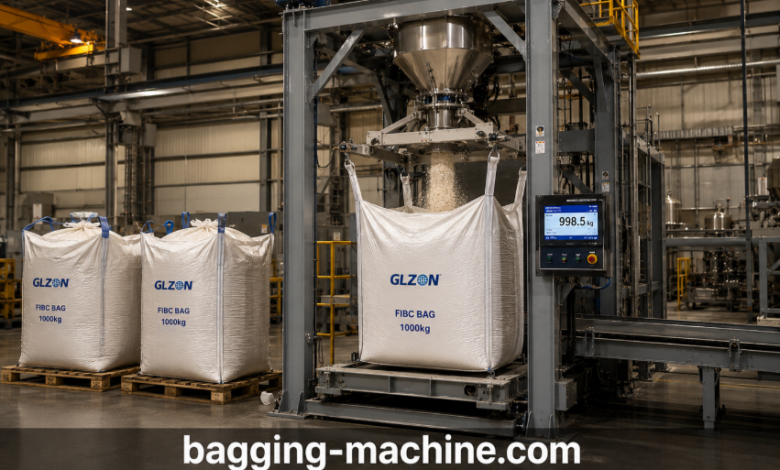
What Is Jumbo Bagging?
Jumbo bagging is the process of filling large flexible bulk containers — commonly called jumbo bags, big bags, super sacks, or FIBCs (Flexible Intermediate Bulk Containers) — with bulk dry or semi-dry materials using a dedicated filling machine.
A single jumbo bag typically holds:
- 500 kg to 2,000 kg of product per bag
- Equivalent to 20 to 80 standard 25 kg bags
- Up to 1 full tonne in a single lift point
Jumbo bagging is the standard bulk packaging method across chemicals, food, agriculture, construction, and mining industries worldwide — wherever moving large quantities of dry material efficiently is a priority.
What Is a Big Bag Filling Machine?
A big bag filling machine (also called a jumbo bag filler, FIBC filling machine, bulk bag filler, or super sack filler) is industrial equipment designed to:
- Support and position a large FIBC during filling
- Accurately weigh and control the quantity of material filled
- Densify the material for a stable, palletizable bag
- Seal and discharge the filled bag onto a pallet
It is not a single component — it is an integrated system of subsystems working together:
| Component | Function |
| Fill frame | Supports bag weight during filling (up to 2,000 kg) |
| Hopper | Holds and releases product into the bag |
| Fill head | Connects hopper to bag inlet; contains dust |
| Load cells | Continuously weighs bag during fill cycle |
| Weight controller | Manages fill valve and shuts off at target weight |
| Densification system | Compacts material; improves bag shape and stability |
| Control panel (PLC/HMI) | Automates and monitors the entire fill cycle |
How Is a Big Bag Filling Machine Different from Smaller Bag Filling Equipment?
This is a critical distinction for operations researching packaging equipment for the first time.
| Factor | Big Bag Filling Machine | Standard Bag Filling Machine |
| Bag capacity | 500–2,000 kg | 5–50 kg |
| Bags per tonne | 0.5–2 bags | 20–200 bags |
| Fill cycle time | 2–6 minutes per bag | 5–30 seconds per bag |
| Labor per tonne | Very low | Higher |
| Packaging cost per kg | Lower | Higher |
| Forklift required | Yes | No |
| Floor space | More | Less |
| Best for | Bulk industrial quantities | Retail / distribution quantities |
Key insight: Big bag filling machines trade higher cycle time per bag for dramatically lower labor cost and packaging cost per tonne — making them the most cost-efficient format for high-volume bulk material movements.
Types of Big Bag Filling Machines
Choosing the right configuration depends on your throughput, material type, budget, and automation requirements.
1. Manual Big Bag Filling Machine
- Operator handles all bag placement, spout connection, and discharge steps
- Machine controls only the weigh-fill cycle
- Throughput: 2–5 bags/hour
- Best for: Very low volume, trial production, occasional-use applications
- Pros: Low cost, simple operation
- Cons: Labor intensive, slow, inconsistent results
2. Semi-Automatic Big Bag Filling Machine
- Operator hangs the bag and attaches the fill spout
- Machine automates filling, weighing, densification, and shutoff
- Operator removes and seals the filled bag
- Throughput: 5–15 bags/hour
- Best for: Low-to-medium volume, multiple materials, limited capital budget
- Pros: Good balance of automation and cost; flexible for different bag sizes
- Cons: Still requires operator presence throughout cycle
3. Automatic Big Bag Filling Machine
- Fully automated: bag placement, spout connection, fill, weigh, densify, seal, and discharge
- Minimal operator involvement — typically one person monitoring the line
- Throughput: 15–30 bags/hour
- Best for: High-volume consistent single-product operations
- Pros: Maximum throughput, minimum labor, consistent results
- Cons: Higher capital cost; less flexible for frequent product changeovers
4. Automated Bulk Bag Filling Machine (Integrated Line)
- Complete packaging line integration: upstream material handling + FIBC filler + downstream pallet conveying + stretch wrapping
- Full PLC/SCADA integration for batch traceability
- Throughput: 20–40+ bags/hour (twin-station configurations)
- Best for: Large-scale manufacturing requiring full automation and traceability
- Pros: Near lights-out operation; full data logging
- Cons: Highest capital investment; requires significant floor space
How a 1,000 kg Big Bag Filling Machine Works — Full Cycle Walkthrough
Here is the complete step-by-step fill cycle for a standard semi-automatic or automatic big bag filling machine:
Step 1 Pallet placement
- An empty pallet is positioned under the fill frame
- Manual placement or automatic pallet conveyor depending on automation level
Step 2 Bag hang
- Empty FIBC is placed on the fill frame
- All four lift loops are hooked securely over the frame arms
- Bag must hang evenly — uneven hanging causes asymmetric loading and seam stress
Step 3 Spout connection and bag inflation
- Bag inlet spout is attached to the fill head and clamped
- Inflator pre-fills the bag with air — fully opens the bag before product enters
- Critical step: skipping inflation causes collapsed bag walls and uneven fills
Step 4 Tare and fill initiation
- Weight controller records tare (empty bag weight)
- Target fill weight is set (e.g., 1,000 kg)
- Fill cycle initiates — material flows from hopper through fill head into bag
Step 5 Two-speed weigh-fill
- Fast fill: High flow rate until approximately 95–97% of target weight
- Dribble feed: Slow flow rate for final 3–5% — lands precisely on target
- Load cells monitor weight continuously; controller adjusts flow in real time
- Typical accuracy: ±0.5% (±5 kg on a 1,000 kg fill)
Step 6 Densification cycle
- Vibrating deck or pneumatic massage pads activate
- Compacts material, drives out trapped air
- Produces a firmer, squarer, more stable bag
- Duration: 30–120 seconds depending on material
Step 7 Fill valve shutoff and spout seal
- Fill valve closes at target weight
- Inlet spout is tied off or heat-sealed
- Fill head disconnects from the bag
Step 8 Bag discharge
- Filled bag lowered onto pallet via frame lowering mechanism or discharge conveyor
- Bag inspected for correct shape and weight label applied
- Pallet moved to stretch wrapping or storage area
Total cycle time: 3–8 minutes per bag depending on material, fill weight, and densification duration.
Materials Commonly Filled in Jumbo Bags
Big bag filling machines handle an enormous range of dry bulk materials. Here are the most common categories:
Free-Flowing Materials (Easiest to Fill)
- Plastic pellets and resins
- Coarse salt and sodium products
- Whole grains and seeds
- Sand and fine aggregates
- Fertilizer granules
Equipment note: Standard hopper geometry, no special flow aids needed.
Semi-Flowing Powders (Moderate Complexity)
- Flour and starch
- Fine sugar
- Ground minerals
- Powdered chemicals
- Dried milk powder
Equipment note: Steeper hopper walls, larger outlet diameter, possible aeration pads.
Cohesive / Non-Flowing Powders (Most Complex)
- Carbon black
- Titanium dioxide
- Fine silica
- Cornstarch
- Pharmaceutical powders
Equipment note: Active flow promotion required — air fluidization, mechanical agitation, or vibration. Full dust containment essential.
High-Density / Abrasive Materials
- Crushed stone and aggregates
- Mineral ores and concentrates
- Cement powder
- Recycled construction materials
Equipment note: Heavy-duty frame, abrasion-resistant hopper liners, high SWL rating.
Automatic Big Bag Filling Machine: When Is Full Automation Worth It?
Full automation is a significant capital investment. Here is how to determine whether it is justified for your operation:
Invest in a Fully Automatic Big Bag Filling Machine When:
- ✅ You fill 20 or more bags per hour consistently
- ✅ You run single shifts of 8+ hours on one product
- ✅ Your labor cost per bag is high relative to equipment ROI
- ✅ You need full batch traceability for regulatory compliance
- ✅ Your material is hazardous or containment-sensitive — minimizing operator contact reduces exposure risk
- ✅ You are scaling production and packaging is already a bottleneck
Stick with Semi-Automatic When:
- ✅ You fill fewer than 15 bags per hour
- ✅ You run multiple materials with frequent changeovers
- ✅ You use multiple bag sizes that change regularly
- ✅ Capital budget limits upfront investment
- ✅ Your operation runs short production runs or seasonal demand
A well-specified automatic bagging machine for jumbo bag applications typically pays back its additional cost versus semi-automatic in 12 to 30 months through labor savings alone — faster in high-wage markets or multi-shift operations.
What About Smaller Bag Formats Running Alongside Jumbo Bags?
Many operations package the same product in both jumbo bags (for bulk wholesale and export) and smaller bags (for retail and distribution). This is a very common scenario in:
- Food ingredients (1,000 kg FIBCs for food manufacturers + 25 kg bags for retailers)
- Fertilizers (jumbo bags for farm bulk delivery + 20 kg bags for garden centers)
- Chemicals (tonne bags for industrial customers + 25 kg bags for smaller users)
- Sand and aggregates (FIBCs for construction sites + 25 kg bags for DIY retail)
For the smaller bag format, an open mouth bagging machine is the most common and cost-effective solution — handling pre-made woven PP, paper, or PE bags from 5 kg to 50 kg with fast, accurate fills.
Running both lines in parallel gives your operation the flexibility to serve every customer segment — bulk industrial buyers through the FIBC line, and retail or trade buyers through the open mouth line.
Key Specifications to Review Before Buying a Big Bag Filling Machine
Do not shortlist any machine without confirming these specifications:
1. Fill Weight Range
- What is the minimum and maximum fill weight the machine handles?
- Confirm it covers your full range — not just your most common weight
2. Weight Accuracy
- What accuracy is guaranteed on your specific material?
- Ask for certified test results — not just brochure specifications
- Target: ±0.5% or better for most applications; ±0.2% for high-value products
3. Fill Rate (Bags per Hour)
- What is the rated throughput on a material similar to yours?
- Ask for realistic cycle times — not best-case theoretical speeds
4. Frame Load Rating
- Must exceed your maximum bag weight with a safety margin
- For 1,000 kg fills: minimum 1,500 kg frame rating; 2,000 kg preferred
5. Hopper Capacity and Geometry
- Sized for at least one full bag fill without running empty mid-cycle
- Geometry validated for your material’s flow characteristics
6. Densification System
- Is it included or an optional extra?
- What type — vibrating deck, pneumatic massage, or combined?
- What is the densification cycle duration and its effect on bag shape?
7. Dust Containment Level
- What dust containment features are standard vs. optional?
- Does it meet your workplace health and safety requirements?
8. Material Contact Surfaces
- Carbon steel (painted) for general industrial materials
- 304 stainless steel for food-grade applications
- 316 stainless steel for corrosive chemical applications
9. Control System
- PLC brand and model (affects spare parts availability)
- Number of product recipes stored
- Data logging and batch record capability
10. Integration Compatibility
- Does it connect to your upstream feed equipment?
- Does it support downstream pallet conveyor and stretch wrapper integration?
Big Bag Filling Machine: Buying Checklist
Before signing any purchase agreement:
- ✅ Frame load rating confirmed for maximum bag weight + safety margin
- ✅ Hopper geometry validated for your material’s flow characteristics
- ✅ Weight accuracy specification met on your actual material (fill trial completed)
- ✅ Fill rate meets your throughput requirement with headroom
- ✅ Densification system specified and included
- ✅ Dust containment level meets workplace safety requirements
- ✅ Material contact surfaces match application (carbon steel / SS304 / SS316)
- ✅ Control system stores all required product recipes
- ✅ Upstream and downstream integration confirmed
- ✅ Spare parts kit pricing and availability confirmed
- ✅ Supplier service coverage in your region confirmed
- ✅ Training and installation support included in purchase scope
Frequently Asked Questions
Q: What is the difference between a jumbo bag, super sack, FIBC, and big bag? They are all the same thing — large flexible woven polypropylene bulk containers designed to hold 500–2,000 kg. “FIBC” is the correct technical term. “Jumbo bag,” “super sack,” and “big bag” are common industry nicknames that vary by region and sector.
Q: How accurate is a big bag filling machine? Modern systems with load cell weighing achieve ±0.1% to ±0.5% accuracy. On a 1,000 kg fill, that means landing within 1–5 kg of target — consistently, batch after batch.
Q: Do I need a densification system? For free-flowing granular materials: usually not essential. For any powder material: yes — densification significantly improves bag stability, fill density, and safe palletizing performance. A bag without densification looks round and bloated; a densified bag is firm and square.
Q: Can I fill hazardous materials in a big bag filling machine? Yes — but the machine must be specified accordingly. Flammable materials require ATEX-rated electrical components. Toxic or highly hazardous materials require full containment systems. Always disclose material hazard classifications to your equipment supplier during the specification process.
Q: How long does a 1,000 kg fill take? Typically 3–6 minutes on a semi-automatic system — including inflation, fill, densification, and spout sealing. Fully automatic systems with faster bag handling and optimized fill profiles can achieve cycles under 3 minutes.
Q: What is a big bag filling station? A big bag filling station is a compact, self-contained unit combining the fill frame, hopper, fill head, and controls in a single footprint. It is the most common entry-level format for operations new to FIBC packaging.
Conclusion
Jumbo bagging is one of the highest-leverage packaging formats available for industrial bulk material operations — delivering the lowest cost per kg packaged, the lowest labor per tonne handled, and the highest throughput per packaging station of any dry bulk bag format.