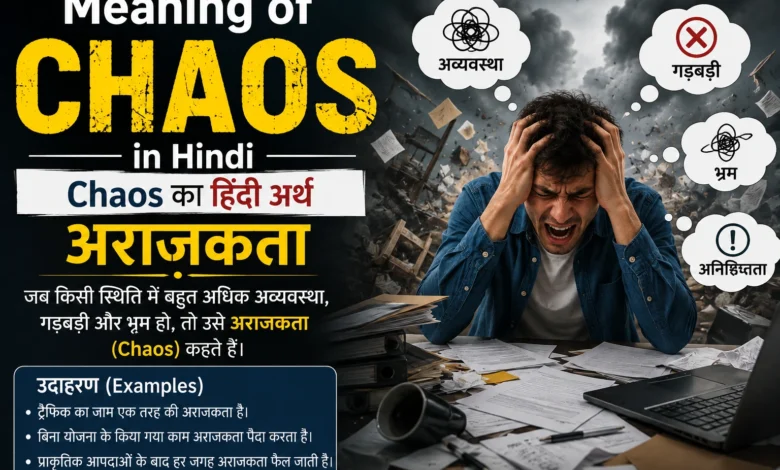
The word “chaos” is commonly used in English when a situation becomes highly disorganized, uncontrolled, or confusing. English learners often search for the meaning of chaos in hindi because the word can have slightly different translations depending on the situation. Understanding its exact meaning can help you use it correctly in conversations, writing, news reports, and everyday situations.
In this guide, you will learn the simple meaning of chaos, its pronunciation, common Hindi translations written in English letters, synonyms, antonyms, grammatical usage, and practical examples. You will also understand the difference between chaos and similar words such as confusion and mess. By the end, you should be able to recognize and use the word naturally in English sentences.
What Is the Meaning of Chaos in Hindi?
The meaning of chaos in hindi can be explained as arajakta, avyavastha, afra-tafri, or gadbadi. All these words describe situations where there is little order, organization, or control. However, they do not always have exactly the same meaning. The most suitable translation depends on what is happening and how serious or disorganized the situation is.
For example, “afra-tafri” may describe a place where people are suddenly rushing around in confusion, while “avyavastha” is more suitable for general disorder or poor organization. “Arajakta” can describe a more serious lack of order or authority. Therefore, understanding the complete sentence is more useful than translating “chaos” with one fixed Hindi word every time.
Chaos Meaning in Simple Words
In simple English, chaos means a state of extreme disorder. Imagine entering a room where objects are everywhere, people are shouting, nobody knows what to do, and nothing is properly organized. Such a situation could be described as chaos. Chaos is stronger than simply saying that something is untidy or slightly confusing.
When someone asks about chaos ka matlab, the easiest explanation is “a situation without proper order or control.” It can describe traffic, an event, a workplace, a school, a home, or even a country during a serious crisis. The word is usually used when the disorder is noticeable enough to make normal activities difficult.
How to Pronounce Chaos
Chaos is pronounced approximately as “kay-os.” The first part sounds like “kay,” and the second part sounds like “os.” A common mistake among beginners is trying to pronounce the word exactly as it is spelled. English spelling can be unusual, so the letters do not always show the pronunciation clearly.
The standard pronunciation is usually represented as “KAY-os.” When learning chaos pronunciation in Hindi or English, remember that the “ch” at the beginning does not sound like the “ch” in “chair.” Listening to the word and repeating it several times can make the pronunciation easier to remember and use confidently.
Different Meanings of Chaos in Hindi
Chaos can have several Hindi equivalents written in English letters. “Avyavastha” refers to disorder or lack of organization. “Afra-tafri” often describes sudden confusion, panic, or uncontrolled movement. “Gadbadi” can mean disorder or something going wrong, while “arajakta” often carries a stronger meaning related to serious disorder or lack of proper control. This shows why understanding words through context is often more useful than relying on one fixed definition.
For example, heavy traffic after an accident may create afra-tafri, while a badly managed office can be described as being in avyavastha. A serious breakdown of law and order may be closer to arajakta. This is why the meaning of chaos in hindi should always be understood according to the context of the sentence.
How Is Chaos Used in English?
Chaos is mainly used as a noun. People often say that a place “is in chaos” when normal order has disappeared. You may also hear expressions such as “total chaos,” “complete chaos,” “cause chaos,” and “create chaos.” These expressions emphasize that a situation has become highly disorganized or difficult to control.
For example, “The sudden power failure caused chaos at the airport” means that the power failure created serious disruption and disorder. “The office was in complete chaos” means that the workplace was extremely disorganized. These common patterns make the word useful when describing situations that are more serious than an ordinary mess. Learning context and usage in English can also make unfamiliar words and expressions easier to understand correctly.
Chaos Meaning With Examples
Examples are one of the easiest ways to understand chaos meaning in Hindi with example sentences. Consider the sentence, “The accident caused chaos on the highway.” In simple Hindi written in English letters, this means that the accident caused afra-tafri or serious avyavastha on the road, making normal traffic difficult.
Another example is, “The classroom was in chaos after the teacher left.” This means the classroom became very disorganized and difficult to control. “The storm created chaos across the city” suggests widespread problems, disruption, and confusion. These examples show that chaos is often connected with situations where normal organization suddenly breaks down.
Examples of Chaos in Everyday Life
Everyday life offers many situations where the word chaos can sound natural. A crowded railway station after several train cancellations may be described as chaotic. Heavy traffic caused by a blocked road may create chaos. A large event with no clear organization, confused staff, and long queues can also become chaotic.
At home, people may jokingly describe a very busy morning as chaos when everyone is rushing, children are getting ready, and things are difficult to manage. However, a slightly untidy room would usually be called a mess rather than chaos. The word works best when there is noticeable disorder, confusion, or loss of control.
Synonyms of Chaos
Several English words have meanings similar to chaos. Common chaos synonyms in Hindi and English contexts include disorder, confusion, turmoil, mess, mayhem, disorganization, anarchy, and pandemonium. However, these words are not completely interchangeable. Some describe mild disorder, while others suggest very serious or dramatic situations.
“Disorder” is a broad term for lack of organization. “Confusion” often relates to uncertainty or difficulty understanding something. “Turmoil” usually describes serious emotional, political, or social disturbance. “Mayhem” suggests wild and uncontrolled activity. “Mess” is generally more casual and can describe something much less serious than chaos.
Antonyms of Chaos
The opposite of chaos usually involves order, control, calmness, or organization. Common antonyms include order, organization, peace, calm, stability, harmony, and control. The best opposite depends on the sentence. If chaos refers to poor organization, “order” may be the strongest antonym. If it refers to panic, “calm” may fit better.
For example, “The room changed from chaos to order” means that a disorganized situation became organized. “After several minutes of chaos, calm returned to the building” shows that panic or disorder ended. Learning antonyms makes the original word easier to understand because they show the contrast between uncontrolled disorder and a stable situation.
Difference Between Chaos and Confusion
Chaos and confusion are related, but they are not identical. Confusion often describes a person’s inability to understand something or a situation where information is unclear. Chaos usually refers to a broader situation where there is serious disorder, poor organization, or lack of control.
For example, “I was confused by the instructions” means the instructions were difficult to understand. Saying “The office was in chaos” means the office itself was badly disorganized. Confusion can exist without physical disorder, while chaos usually suggests that the overall situation has become difficult to manage or control.
Chaos as a Noun
Chaos is normally an uncountable noun in standard English. This means people generally say “chaos” rather than “a chaos” or “many chaoses” in ordinary conversation. For example, “There was chaos outside the stadium” is natural English, while “There was a chaos outside the stadium” would normally sound incorrect.
You can combine chaos with descriptive words such as complete, total, absolute, or organized. Sentences such as “The situation turned into complete chaos” and “The delay caused total chaos” are common. Understanding this grammatical pattern can help English learners avoid mistakes and use the word naturally in both spoken and written English.
Meaning of Chaotic in Hindi
“Chaotic” is the adjective form related to chaos. Chaotic meaning in Hindi can be expressed as avyavasthit, arajak, or afra-tafri wala, depending on the situation. While “chaos” names the disorder itself, “chaotic” describes a place, situation, event, or experience that contains a lot of disorder.
For example, “The station was chaotic” means the station was extremely disorganized or full of confusion. “It was a chaotic morning” means the morning involved many uncontrolled or poorly organized activities. Remembering this distinction makes it easier to choose between the noun “chaos” and the adjective “chaotic.”
Common Phrases Using Chaos
Several common English expressions use the word chaos. “Total chaos” and “complete chaos” describe extreme disorder. “Cause chaos” and “create chaos” mean to produce a seriously disorganized situation. “Throw something into chaos” means to suddenly disrupt normal order, while “descend into chaos” describes a situation gradually becoming uncontrolled.
The phrase “organized chaos” is also commonly used. It describes something that looks disorganized from the outside but still works effectively for the people involved. For example, a busy creative workplace may appear like organized chaos because many activities happen at once, yet employees still understand how everything operates.
Common Mistakes While Using Chaos
One common mistake is treating chaos as a countable noun. In normal English, you should say “There was chaos” rather than “There was a chaos.” Another mistake is confusing “chaos” with “chaotic.” Chaos is a noun, while chaotic is an adjective. You can say “The event was chaotic” or “The event ended in chaos.”
Learners may also use chaos for situations that are too minor. If your desk has a few papers on it, “messy” may sound more natural than “chaotic.” Chaos usually suggests a stronger level of disorder. Correct pronunciation is another important point because the beginning of “chaos” sounds like “kay,” not the usual English “ch” sound.
Interesting Facts About the Word Chaos
The word “chaos” has a long history and comes ultimately from an ancient Greek word. Its meaning developed over time, and in modern everyday English it commonly refers to extreme disorder, confusion, or lack of organization. It can be used for both physical situations and broader social or organizational problems.
The word is also useful because its intensity can change according to context. People may use it seriously to describe emergencies and major disruptions, or casually to describe a very busy household or workplace. Understanding this flexibility helps learners recognize when the word is being used literally and when it is being used more informally.
FAQs
What is the meaning of chaos in Hindi?
The meaning of chaos in hindi can be explained as arajakta, avyavastha, afra-tafri, or gadbadi. It describes a situation with little order, control, or organization. The most appropriate Hindi meaning depends on the context in which the word is being used.
What is chaos called in Hindi?
Chaos can be translated as avyavastha, arajakta, afra-tafri, or gadbadi. Each translation has a slightly different tone. For example, afra-tafri often refers to sudden confusion, while avyavastha generally refers to poor organization or disorder.
What does chaos mean in simple words?
Chaos means extreme disorder or lack of control. It describes a situation where things are badly organized, people may be confused, and normal activities become difficult. Traffic problems, emergencies, crowded events, and badly managed workplaces can sometimes be described as chaos.
How do you pronounce chaos?
Chaos is pronounced approximately as “KAY-os.” The letters “ch” at the beginning do not have the same sound as the “ch” in words such as chair or child. Practicing “kay-os” slowly can help English learners remember the correct pronunciation.
What are the synonyms of chaos?
Common synonyms of chaos include disorder, confusion, turmoil, mayhem, mess, disorganization, anarchy, and pandemonium. These words have related meanings, but their intensity and usage differ. “Mess,” for example, is often more casual and less serious than “chaos.”
What is the opposite of chaos?
Common opposites of chaos include order, organization, calm, peace, stability, harmony, and control. The correct antonym depends on context. If chaos means poor organization, “order” works well, while “calm” may be better when chaos describes panic.
What is the difference between chaos and confusion?
Confusion usually describes uncertainty, misunderstanding, or difficulty understanding something. Chaos refers more strongly to disorder and lack of control. A person can feel confused without any physical disorder, while a chaotic situation usually involves broader disruption or disorganization.
What is chaotic meaning in Hindi?
Chaotic can mean avyavasthit, arajak, or afra-tafri wala in Hindi written using English letters. It is an adjective used to describe something that is extremely disorganized or uncontrolled. For example, “a chaotic office” means a workplace with serious disorder.
Conclusion
The meaning of chaos in hindi is generally connected with arajakta, avyavastha, afra-tafri, or gadbadi. The best translation depends on the sentence and situation. In simple terms, chaos describes serious disorder, lack of organization, or loss of control. It is pronounced “KAY-os” and is mainly used as an uncountable noun.
Learning the difference between chaos, confusion, mess, and chaotic can make your English more accurate. Instead of memorizing one translation, focus on how the word is used in real sentences. This approach will help you understand its meaning more clearly and use it naturally in everyday English.