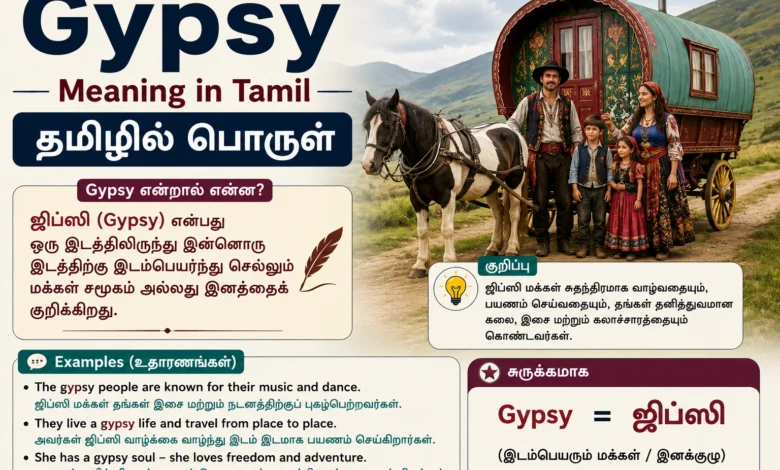
Many readers come across the word “gypsy” in books, films, songs, or travel writing and want to understand its full meaning. Because the word carries historical, cultural, and sensitive connotations, people often search for gypsy meaning in tamil to understand not just the translation but also how the word is viewed today.
This article explains the meaning of “gypsy,” its pronunciation, its historical background, how it is used in modern English, and why many people now prefer terms like “Romani” or “Roma.” You will also learn about respectful alternatives and common mistakes to avoid when using this word in conversation or writing.
What Is the Meaning of Gypsy in Tamil?
When people search for gypsy meaning in tamil, they are usually trying to understand a word historically used in English to describe people belonging to the Romani ethnic group. In Roman Tamil, this idea has sometimes been explained loosely as alaindhu thirivor, meaning people who wander or travel from place to place, though this explanation is a simplification rather than an exact translation.
It is important to understand that this broad, informal meaning can be inaccurate and culturally insensitive when applied directly to Romani people as a group. Not every Romani person travels or lives a nomadic lifestyle, and using the word this way can spread inaccurate assumptions. For this reason, “Romani” or “Roma” is generally considered a more accurate and respectful term when referring specifically to this ethnic community. This is why preserving cultural meaning in translation is important when a direct word-for-word translation does not fully explain a term’s historical or cultural background.
Gypsy Meaning in Simple Words
In simple English, Gypsy Meaning in Tamil was historically used as a label for people belonging to the Romani community, an ethnic group with its own distinct history, languages, and traditions. Over time, this label became widely used in Europe and other parts of the world, though it was not a term that Romani communities created for themselves.
The word has also been used figuratively to describe someone who travels often or does not settle in one place for long. However, this figurative use can still carry stereotypes borrowed from assumptions about Romani people, so many writers today choose more precise words such as “traveler” or “wanderer” instead, depending on what they actually mean.
How to Pronounce Gypsy
The word “gypsy” is pronounced as JIP-see, with two clear syllables. The first sound is similar to the “j” in the English word “job,” followed by a short “i” sound, and ending with a soft “see” sound. The stress falls on the first syllable.
A common pronunciation mistake among learners is softening the initial “j” sound too much or blending the two syllables together. Practicing the word slowly, syllable by syllable, and listening to clear audio examples can help Tamil-speaking learners pronounce it accurately and confidently in conversation.
Historical Meaning of Gypsy
The historical origin of “gypsy” traces back to a mistaken European belief that Romani people had originally come from Egypt. Over centuries, this incorrect assumption led to the shortened term “gypsy” being applied broadly to Romani communities across Europe, even though their actual origins trace back to regions in South Asia.
It is important to recognize that Romani people have their own rich history, distinct languages, and diverse cultural traditions that developed over many centuries. They should not be reduced to a single label or a set of assumptions inherited from an inaccurate historical term. Understanding this background helps explain why many communities today prefer more accurate terminology.
Modern Meaning and Usage of Gypsy
In modern English, the word “gypsy” still appears in older books, films, song titles, travel writing, and historical documents. These sources often reflect the language of the time period in which they were created, rather than current, respectful terminology used by informed writers and speakers today. This demonstrates why understanding a word through context is often more useful than relying on a single definition without considering where and how the term appears.
Whether the word is appropriate in modern usage depends heavily on context. When referring to historical texts or quoting original sources, the word may appear as part of accurate quotation. However, when describing real people today, it is generally better to use the specific term an individual or community prefers, such as “Romani” or “Roma,” rather than the older, broader label.
Is Gypsy an Offensive Word?
Many Romani people and organizations that represent Romani communities consider the word “gypsy” offensive, outdated, or pejorative, particularly when it is used as a general label for the entire ethnic group. This is an important consideration for anyone searching for gypsy meaning in tamil or trying to use the word respectfully.
At the same time, opinions about the word can vary by region, community, and individual preference, so it would be inaccurate to claim that every single person views it the same way. Because of this variation, the safest and most respectful approach is to use more specific and accurate language, such as “Romani” or “Roma,” whenever possible.
Difference Between Gypsy and Romani
“Gypsy” and “Romani” are related but not identical terms. “Romani” refers specifically to an ethnic group with its own distinct history, languages, and cultural traditions that developed over centuries across different regions of the world.
“Gypsy,” on the other hand, is an older external label that outsiders applied to Romani communities, often inaccurately and sometimes with negative connotations. Because of this history, the two words should not be treated as exact synonyms. When accuracy and respect matter, “Romani” is generally the more appropriate choice.
Roma and Romani Meaning
“Roma” and “Romani” are two closely related terms used to describe this ethnic group. The Roma is often used to refer to the people collectively, functioning as a plural noun in many contexts. “Romani” can function as an adjective, as in “Romani language” or “Romani culture,” and in some contexts is also used as a noun.
Preferred terminology can vary between different Romani communities and regions, so there is no single universal rule that applies everywhere. When writing or speaking about this community, it is helpful to follow the terms that a specific individual, group, or organization uses to describe themselves.
Gypsy Meaning in Different Contexts
The meaning of “gypsy” can shift depending on where and how it appears. Historical writing, it often reflects the language used during a particular time period. In modern conversation, its use is far more limited and should be approached carefully.
In media, literature, and cultural references, the word sometimes appears in titles, quotations, or figurative expressions. A careful reader should consider whether the word is being quoted from a historical source, used as part of a title, or applied directly to describe real people, since each situation calls for a different level of caution.
Gypsy Meaning With Examples
Historical and quoted usage helps illustrate the word without applying it directly to real people today. For example, an older novel might include the sentence, “The traveling group was described in the book as gypsies,” meaning intha kuzhu pazhaiya puthagathil andha vaartaiyai payanpaduthi irundhanar, referring to language used at the time of writing.
Another example might involve a historical document stating, “European records from earlier centuries often referred to Romani travelers as gypsies,” meaning pazhaiya aavanangalil intha vaarthaiyai payanpaduthiyirunthanar, referring again to the language of that specific time period. Such examples show the word appearing in historical or quoted contexts rather than as a casual modern label.
Respectful Alternatives to Gypsy
When referring to the ethnic group specifically, “Romani” or “Roma” are the most accurate and widely recommended terms. When referring to someone who travels frequently or does not stay in one place, more precise words such as “traveler,” “nomadic person,” “itinerant worker,” “mobile community,” or “traveling community” may be appropriate instead.
These alternatives are not interchangeable in every situation. “Romani” refers specifically to ethnic identity, while “traveler” simply describes a pattern of movement without any connection to a particular ethnic group. Choosing the right word depends on what the writer or speaker actually intends to communicate.
Difference Between Gypsy and Traveler
“Gypsy” and “traveler” do not automatically mean the same thing, even though they are sometimes used interchangeably in casual speech. “Traveler” can describe anyone who travels frequently, and in some regions, it also refers to specific communities with their own distinct identity, separate from Romani ethnicity.
“Romani,” by contrast, refers to a specific ethnic group with its own history and culture. Confusing these terms can lead to inaccurate assumptions about who belongs to which community. Careful word choice helps avoid blending distinct groups and identities into one inaccurate label.
Difference Between Gypsy and Nomad
A nomad is generally defined as a person or community that moves from place to place rather than settling permanently in one location. This definition applies to various groups around the world and is not limited to any single ethnicity.
It is inaccurate to assume that being Romani automatically means being nomadic, since many Romani individuals and families live settled lives in permanent homes. Using “gypsy” as a simple synonym for “nomad” reinforces this inaccurate assumption and can carry unintended stereotypes about an entire community.
Gypsy in Literature and Media
The word “gypsy” has appeared in older literature, films, music, and historical records for many decades. These works often reflect the language and attitudes common during the time they were created, which may differ significantly from how careful writers approach the topic today.
Readers encountering the word in older books or films can understand it within its historical context without assuming that it represents the best or most accurate language for describing Romani people in modern writing. Recognizing this distinction helps readers engage with older works thoughtfully while still using more respectful language in current communication.
Figurative Use of Gypsy
At times, “gypsy” has been used figuratively to describe someone seen as free-spirited or frequently changing locations, unrelated to any specific ethnic background. This figurative usage appears in phrases describing lifestyle or personality traits.
However, this figurative use may still be considered insensitive, since it borrows imagery and assumptions historically associated with Romani people. Writers who want to describe a free-spirited or frequently moving lifestyle can instead use more precise words such as “traveler,” “wanderer,” or “nomadic,” which avoid connecting the description to a specific ethnic identity.
Gypsy as a Noun and Adjective
Historically, “gypsy” has been used both as a noun, referring to a person, and as an adjective, describing something associated with that label, such as “gypsy music” or “gypsy style.” These grammatical patterns appear frequently in older texts and cultural references.
In modern, respectful writing, it is best to avoid using the word casually as a label for people unless discussing historical language, quoting an original source directly, or referring to a term that a person or group has specifically chosen for themselves. This careful approach helps prevent unintended disrespect toward Romani communities.
Common Phrases Containing Gypsy
Some expressions in English include the word “gypsy,” often connected to ideas of travel, music style, or lifestyle. These phrases typically reflect historical or cultural usage from earlier periods rather than terminology recommended for modern conversation.
Where such expressions have become controversial or are better avoided, more neutral alternatives exist. For example, instead of describing a flexible work arrangement as a “gypsy lifestyle,” a writer might use “flexible” or “location-independent” instead, which conveys the intended meaning without relying on an outdated label.
Common Mistakes While Using Gypsy
A common mistake is assuming that all Romani people are nomadic, when in fact many live settled lives in permanent communities. Another mistake is using “gypsy” as a generic synonym for “traveler” or “nomad,” which blurs distinct meanings and can spread inaccurate assumptions.
Some people also mistakenly treat stereotypes as established facts or assume the word is universally acceptable in every context. Because opinions and preferences vary, it is best to check how individuals or communities identify themselves before using any specific term to describe them.
Synonyms and Related Words
There is no single perfect synonym for “gypsy,” since its historical and ethnic meanings are specific and cannot be fully captured by one alternative word. Related terms include Romani, Roma, traveler, nomad, wanderer, and itinerant, each carrying a slightly different meaning and context.
These words are not always interchangeable. “Romani” and “Roma” refer to ethnic identity, while “traveler,” “nomad,” “wanderer,” and “itinerant” describe patterns of movement without necessarily indicating any particular ethnicity. Choosing the correct term depends on what the writer actually intends to describe.
Interesting Facts About the Word Gypsy
The word “gypsy” originates from a historical misunderstanding that connected Romani people to Egypt, even though their ancestry actually traces back to regions in South Asia many centuries ago. This mistaken origin shaped how the word spread across European languages over time.
Romani populations today include diverse communities spread across many countries, each with its own languages, traditions, and national identities. Rather than forming a single uniform group, Romani communities reflect a wide range of cultural practices and histories that continue to evolve across generations.
FAQs
What is gypsy meaning in Tamil?
Gypsy meaning in tamil is often explained loosely as alaindhu thirivor, or wandering people, though this is a simplified idea rather than an exact translation. It historically referred to Romani people.
What does gypsy mean in simple words?
In simple words, “gypsy” was a historical label for Romani people, sometimes also used figuratively for someone who travels often, though this usage can carry stereotypes.
Is gypsy an offensive word?
Many Romani people and organizations consider “gypsy” offensive or outdated, especially as a general label. Opinions vary, so respectful, specific language is recommended.
What is the difference between gypsy and Romani?
“Romani” refers to a specific ethnic group with its own history and culture, while “gypsy” is an older external label often applied inaccurately by outsiders.
What does Romani mean?
“Romani” refers to an ethnic group with distinct languages, traditions, and history. It can be used as both an adjective and, in some contexts, a noun.
Are all Romani people nomadic?
No, not all Romani people are nomadic. Many live settled lives in permanent homes, so assuming otherwise reflects an inaccurate stereotype about the community.
What is the difference between gypsy and traveler?
“Traveler” describes someone who moves frequently and does not always refer to ethnicity, while “Romani” specifically refers to an ethnic identity with its own culture.
What is the difference between gypsy and nomad?
A nomad is anyone who moves frequently rather than settling permanently. Being Romani does not automatically mean being nomadic, so the words are not interchangeable.
How do you pronounce gypsy?
“Gypsy” is pronounced JIP-see, with stress on the first syllable. The initial sound resembles the “j” in “job,” followed by a short “i” and soft ending sound.
Conclusion
Understanding gypsy meaning in tamil involves recognizing both its historical connection to the Romani people and the cultural sensitivity surrounding its modern use. While the word has appeared for centuries in literature, media, and everyday language, many people today consider it outdated or offensive when used as a general label.
When referring specifically to the ethnic group, “Romani” or “Roma” are more accurate and respectful choices. When the intended meaning relates to travel or lifestyle rather than ethnicity, words like “traveler” or “nomad” convey the idea more precisely. Choosing thoughtful, accurate language helps readers communicate clearly and respectfully in any context.


