Chloe Dobbs has attracted public attention through political commentary, television debates, online content, and her appearance in a controversial Channel 4 documentary series. She often discusses immigration, British politics, culture, and public policy from a conservative perspective. Her direct communication style has earned both supporters and critics. Although her media profile has grown quickly, reliable information about her family, exact birthday, finances, and private life remains limited. This article separates confirmed career details from unsupported claims that frequently appear on biography websites.
Chloe Dobbs at a Glance
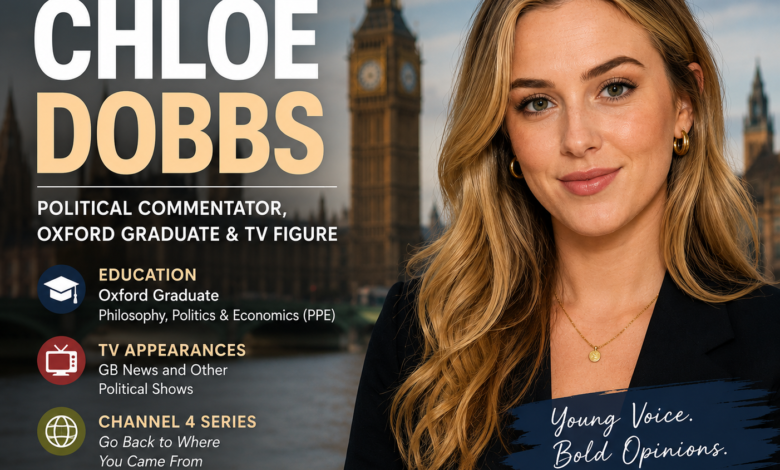
The following table summarizes the most dependable information available about her education, work, public profile, and television experience. Several personal details remain unconfirmed, so the table avoids presenting estimates as established facts. Public professional profiles identify her as an Oxford PPE graduate, political commentator, and tutor, while media coverage connects her with Cornwall, GB News, online political content, and Channel 4’s immigration-focused series.
| Detail | Information |
| Full name | Chloe Dobbs |
| Nationality | British |
| Reported home region | Cornwall, England |
| Profession | Political commentator, digital creator, and academic tutor |
| Education | Philosophy, Politics and Economics at the University of Oxford |
| Political outlook | Commonly described as conservative or right-leaning |
| Known for | Political debate appearances and commentary on British current affairs |
| Television appearances | GB News and other discussion-based media |
| Documentary series | Go Back to Where You Came From |
| Age | Reported as 24 in February 2025 |
| Exact birth date | Not publicly verified |
| Family information | Largely private |
| Net worth | No verified public figure |
| Main discussion areas | Immigration, government policy, political parties, culture, and media |
| Additional work | Mathematics, economics, and university admissions tutoring |
Who Is Chloe Dobbs?
Chloe Dobbs is a British political commentator who gained visibility by appearing in televised debates and sharing opinions about government, immigration, culture, and public institutions. News organizations often introduce her as a conservative commentator, while her professional profile highlights an Oxford education and tutoring work. She does not appear to hold elected office or an official party position. Instead, she works within the growing media space where independent commentators respond to breaking stories, debate other guests, and build audiences through television and social platforms.
Her public reputation rests largely on direct arguments rather than neutral news reporting. She regularly presents a clear position, challenges opposing guests, and uses strong language to make her views memorable. That approach works well in modern television, where producers often invite guests with contrasting beliefs to create fast-moving discussions. It can also make her a polarizing figure. Some viewers value her willingness to speak plainly, while others criticize the substance, tone, or wider consequences of her political arguments.
Education and Academic Background
Public professional information describes Dobbs as a graduate of the University of Oxford, where she studied Philosophy, Politics and Economics, commonly known as PPE. This multidisciplinary degree combines political institutions, moral and philosophical questions, economic reasoning, and analytical writing. The education does not automatically make every political argument correct, but it helps explain why she often frames her opinions through policy, incentives, public spending, political responsibility, and the long-term effects of government decisions. For another example of how education can shape a professional media career, read about Maureen Grise’s education and work in visual journalism.
Her academic background also connects with her work outside television. Her public professional profile lists mathematics, economics, and Oxford admissions tutoring among her activities. Tutoring requires a different communication style from political debate because students need clear explanations, careful preparation, and constructive feedback. This part of her career suggests that she has built professional interests around both education and public commentary. However, detailed information about specific employers, tutoring companies, clients, or long-term business arrangements remains limited in reliable public sources.
An Oxford degree also contributes to the way media outlets present her. Producers can introduce her as a young commentator with academic training rather than simply as a social media personality. At the same time, education often becomes part of the criticism directed at her. Reviewers of her Channel 4 appearance questioned how she applied academic reasoning to the human situations shown on screen. This tension between formal education and provocative commentary has become an important part of her public image.
Political Commentary and Media Career
Television Debate Appearances
Chloe Dobbs has appeared in numerous GB News discussions covering immigration, political reform, culture, public spending, party leadership, celebrity opinions, and social policy. The network has repeatedly identified her as a political commentator and included her in programs built around disagreement between guests. She has debated proposals concerning politicians’ outside employment, criticized the Conservative Party’s political direction, and joined conversations about asylum seekers and public safety. These appearances established her as a recurring media guest rather than a one-time television participant. Readers interested in another British media voice can explore Annabel Denham’s journalism and political commentary career.
The format of these programs rewards short, clear, and emotionally forceful statements. Guests must usually explain their position quickly before another panelist responds. Chloe Dobbs often uses this environment to argue that major political parties ignore concerns held by ordinary voters. For example, she has criticized Conservative politicians for moving too far toward the political center or left, particularly on immigration and cultural issues. Whether viewers agree with her or not, her delivery makes her arguments easy to recognize and share online.
Panel-Based Current Affairs
Her work has extended beyond individual interviews. GB News included her on The Saturday Five, a panel program that brings together people with differing views to discuss politics, culture, crime, religion, and mental health. Panel-based shows require participants to respond to several topics instead of focusing on one specialist subject. Her inclusion demonstrates that broadcasters view her as a general current-affairs voice who can comment across multiple areas rather than only on immigration policy.
Frequent television appearances can quickly expand a commentator’s public profile because short video clips often circulate beyond the original broadcast. A heated exchange may appear on social media, news websites, or video platforms within hours. This system helps explain how relatively new commentators can become searchable public figures without holding traditional positions in newspapers, political parties, or research organizations. Dobbs has built much of her recognition through this hybrid model of television exposure and digital distribution.
Chloe Dobbs and Go Back to Where You Came From
Her widest mainstream exposure came through Go Back to Where You Came From, a four-part Channel 4 series broadcast in 2025. The program brought together six British participants with sharply different opinions about immigration and refugees. Producers divided them into groups and sent them through parts of Syria, Somalia, Lebanon, and Kenya to encounter displaced families and follow routes connected with refugee journeys. The production used security teams because the participants traveled through dangerous and politically unstable areas.
Her Starting Position
At the beginning of the series, she expressed strongly restrictive views about immigration and warned about the cultural consequences she believed Britain could face. Media coverage identified her as a conservative commentator from Cornwall who already understood that audiences would consider her opinions controversial. Reviewers also focused on remarks she made while observing children searching through waste in Raqqa. Those comments became a major part of the criticism surrounding both her appearance and the program’s editorial choices.
The program did not present the participants as policy experts conducting formal research. Instead, it used the emotional and dramatic structure of reality television. Viewers watched people with opposing positions argue, travel, meet refugees, experience difficult environments, and reflect on what they saw. Critics questioned whether a protected television production could meaningfully reproduce the fear, hunger, uncertainty, and danger faced by people escaping war. Refugee organizations also warned that the format risked turning suffering into entertainment.
How the Experience Affected Her Views
After returning to Britain, Dobbs said the journey changed parts of her thinking, although she did not completely reverse her position. She continued to support strict vetting and controlled legal immigration. However, she said the experience helped her see displaced people as individuals facing heartbreaking circumstances instead of viewing them mainly through the language of crime or border enforcement. She also recognized that the global displacement crisis extends far beyond the relatively small portion discussed in British news coverage.
This response added more complexity to her public image. The series did not transform her into a supporter of open borders, nor did she claim that it had done so. Instead, she described an increase in empathy alongside continued support for stronger immigration controls. That distinction matters because political experiences rarely produce complete ideological conversions. People may keep their policy preferences while changing the way they understand the individuals affected by those policies.
Reaction to the Program
The show generated mixed reviews. Some critics called it sensational, uncomfortable, or ethically questionable because it relied on provocative participants and emotionally charged situations. Others argued that the format exposed viewers to opinions that already exist in British society and created opportunities for participants to encounter realities they might otherwise never see. Channel 4 described the project as an attempt to explore divided public opinion and encourage understanding, while charities disagreed over whether the program humanized refugees or simplified their experiences.
For Dobbs, the program created a level of recognition beyond regular political panels. It placed her inside a long-form story where viewers could compare her initial statements with her later reflections. She reported receiving hostile messages after the episodes aired, showing how participation in controversial television can affect a person beyond the screen. The experience also demonstrated that audiences often respond more strongly to a commentator’s personality and emotional reactions than to a carefully structured policy argument.
Public Views, Debate Style, and Controversy
Dobbs generally approaches politics from a conservative perspective. Her television comments have included criticism of high immigration, opposition to what she sees as excessive progressive influence, and dissatisfaction with the direction of the Conservative Party. In one GB News discussion, she argued that the party had moved too far left and failed to represent voters concerned about immigration. In another, she supported strict controls regarding migrants housed in British communities.
Her political style depends heavily on certainty. She often presents her conclusions as common sense and frames opposing policies as disconnected from public concerns. This technique can make complicated topics feel easier to understand, but it can also reduce space for uncertainty, legal detail, or competing evidence. Immigration, asylum law, public safety, and cultural integration involve many different groups and circumstances. Strong television statements may communicate a position effectively without providing a complete explanation of those issues.
Controversy has therefore become closely connected with her media identity. Some critics object to the way she describes migrants, political opponents, or cultural change. Supporters may see the same statements as honest arguments that mainstream politicians avoid. A balanced biography should neither promote her conclusions as unquestionable facts nor dismiss her entirely because her views create disagreement. It should explain what she does, where she appears, how media outlets describe her, and why her statements generate attention.
Online Presence, Tutoring, and Professional Direction
Dobbs uses digital platforms to extend her work beyond television. Search results connect her with political videos, short-form commentary, Instagram content, and the name “Dobbs and Policy.” Social platforms allow her to speak without waiting for a television invitation, respond quickly to breaking events, and develop a direct relationship with viewers. They also allow news programs to recirculate her broadcast appearances as short clips, giving each debate a longer life after the original program ends.
Her tutoring work provides another professional direction. Publicly available profile information associates her with mathematics, economics, and Oxbridge admissions support. These services fit naturally with her academic background and may offer more stable work than freelance media appearances. However, reliable sources do not provide full income details or a complete list of her business interests. Claims that label her a major entrepreneur or assign her several businesses should therefore be treated carefully unless stronger documentation becomes available.
The combination of commentary, education, and digital content reflects a modern career model. A young professional can teach students, appear on television, post videos, build a personal brand, and participate in documentary projects at the same time. This structure differs from the older path in which political commentators usually worked first as newspaper journalists, party advisers, or academic researchers. It gives newer voices faster access to audiences, although it also exposes them to rapid criticism and public scrutiny.
Chloe Dobbs Age, Family, Personal Life, and Net Worth
Reliable reporting described her as 24 years old in February 2025. That information suggests she was born around 2000 or early 2001, depending on her birthday. However, no dependable mainstream source reviewed for this article confirms a complete date of birth. Some biography websites claim that she was born in June 2000, but they do not clearly show where the information originated. It is safer to report the documented age at the time of publication rather than present an exact birthday as confirmed.
Information about her parents, siblings, relationships, and family background remains largely private. Her public work focuses on politics and education rather than personal lifestyle content. No reliable reporting establishes whether she is married, dating, or has children. This absence should not encourage speculation. Public figures can choose to discuss political issues without giving audiences access to every part of their private lives, particularly when relatives have not chosen media attention for themselves.
Her net worth has also not been verified. She may earn income from tutoring, digital content, media appearances, and other professional activities, but no public financial records provide a dependable total. Exact amounts published on celebrity biography sites should be viewed cautiously unless they are supported by company filings, property records, financial disclosures, or direct statements. A responsible answer is that her personal wealth remains unknown rather than attaching a speculative number to her name.
Why Her Public Profile Matters
Dobbs represents a wider change in political media. Television channels increasingly rely on younger independent commentators who combine academic credentials, social media activity, and strong ideological identities. These guests can respond quickly, communicate in memorable language, and generate clips that attract online engagement. Their influence does not depend on winning an election or working for a major newspaper. Instead, attention itself becomes a form of professional value.
Her Channel 4 experience also shows the difference between debating a political issue from a studio and meeting people affected by it directly. She kept many of her policy beliefs, yet she said the journey increased her empathy and changed how she viewed displaced people. That outcome illustrates why long-form experiences can reveal complexity that short television arguments often miss. Her future career may depend on whether she continues developing that complexity or returns mainly to confrontational media exchanges.
FAQs
What is she known for?
She is known for conservative political commentary, appearances on British current-affairs programs, online political content, and participation in Channel 4’s Go Back to Where You Came From. Her discussions often focus on immigration, political parties, culture, and government policy.
Did she attend the University of Oxford?
Yes. Public professional information describes her as an Oxford graduate who studied Philosophy, Politics and Economics. That academic background supports her work in political analysis, economics tutoring, and university admissions guidance.
How old is she?
Media coverage reported that she was 24 in February 2025. Her exact date of birth has not been confirmed by a reliable mainstream source, so current age estimates may vary depending on when her birthday falls.
Did the Channel 4 program change her opinion on immigration?
She said it changed her views in several ways and increased her empathy for refugees and displaced people. However, she did not completely reverse her position and continued supporting strong vetting and controlled legal immigration.
What is her net worth?
No verified net-worth figure is publicly available. She appears to earn money through tutoring, commentary, digital activity, and media work, but available sources do not provide enough financial evidence to calculate her wealth responsibly.
Conclusion
Chloe Dobbs has built a growing public profile through political debate, academic tutoring, digital content, and controversial television. Her Oxford education and confident delivery help her stand out in Britain’s crowded commentary space. Channel 4’s Go Back to Where You Came From introduced her to a broader audience and showed that direct experience increased her empathy without completely changing her immigration views. While her professional activity is well documented, her exact birthday, family life, and net worth remain private or unverified.