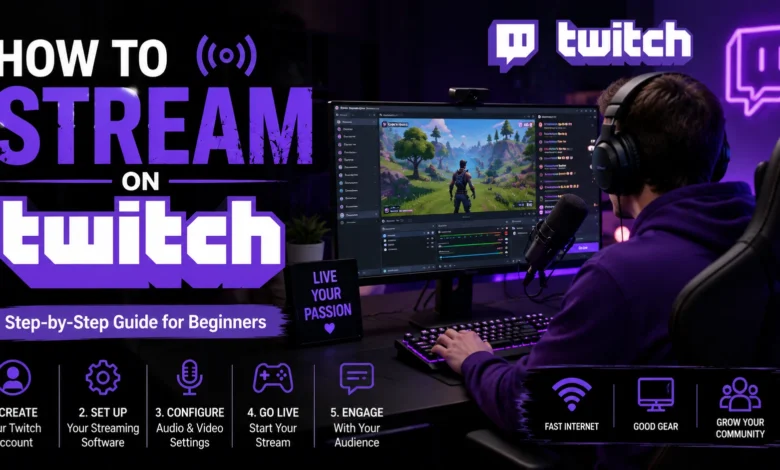
Learning how to stream on Twitch can feel overwhelming when you first encounter scenes, encoders, microphones, cameras and bitrate settings. The good news is that a beginner does not need an expensive studio or advanced technical knowledge. A reliable internet connection, a Twitch account and a suitable computer or console are enough to begin experimenting with live broadcasting and building confidence in front of an audience.
Twitch allows creators to broadcast gameplay, conversations, creative projects and other live content while interacting with viewers through chat. You can stream from a PC, laptop, PlayStation or Xbox, with each method offering different levels of simplicity and control. This guide explains the essential equipment, OBS setup, console options, stream settings, audio quality and practical steps needed to launch your first Twitch broadcast successfully.
What You Need Before Streaming on Twitch
A Twitch stream needs three essential components: a stable internet connection, a device capable of running or capturing your content, and an encoder that sends the broadcast to Twitch. The encoder may be software such as OBS Studio or functionality built directly into a supported games console. Twitch also uses a stream key to authorise broadcasts, although many applications now allow direct account connections instead.
Your starter equipment can remain surprisingly simple. A headset microphone is often enough for early streams, while a webcam is entirely optional. Clear audio and stable video normally matter more than decorative overlays or expensive lighting. Protect your Twitch account carefully, use appropriate security settings and never display your stream key publicly. Twitch specifically warns creators not to share this key because it can authorise another person to broadcast to their channel.
How to Stream on Twitch From a PC
For beginners researching how to stream on Twitch from a PC, broadcasting software provides the most flexible setup. Start by creating your Twitch account and installing reputable streaming software such as OBS Studio. After connecting OBS to Twitch, create a scene for your broadcast and add sources for the game, microphone, desktop audio and webcam if required. These elements combine to create the final video viewers will see.
Before going live, open your chosen game and confirm that OBS is capturing the correct window. Speak into your microphone while watching the audio meter and make sure the game sound does not overpower your voice. Check your stream title and category on Twitch, close private notifications, and perform a short test. Testing prevents simple mistakes such as silent microphones, duplicated audio, incorrect displays or private information appearing during the broadcast.
How to Stream on Twitch With OBS Studio
Understanding how to stream on Twitch with OBS is useful because OBS gives creators detailed control without requiring paid broadcasting software. OBS organises your production using scenes and sources. A scene can represent your main gameplay layout, while sources inside it might include Game Capture, your microphone, webcam, text or graphics. You can eventually create additional scenes for chatting, breaks and the beginning or end of your stream.
OBS recommends that new users begin with its Auto-Configuration Wizard, which considers hardware resources and network conditions when suggesting settings. You can then add the sources needed for your stream and test everything before broadcasting. OBS strongly encourages testing before a first live session rather than immediately pressing Start Streaming, as a short test can reveal performance, sound and capture problems before viewers encounter them.
Choosing Good Twitch Stream Settings
Beginners often assume that the highest resolution and frame rate automatically produce the best stream, but that approach can create unnecessary problems. Streaming quality depends on your computer, encoder, game and upload connection. A modest but stable broadcast usually delivers a better experience than a sharper stream that constantly freezes, buffers or drops frames. Your settings therefore need to balance visual quality with reliable performance.
OBS provides separate controls for canvas resolution, output resolution, frame rate and bitrate. Its documentation also notes that streaming at 60 frames per second can place greater demands on a system than 30 frames per second. Rather than copying settings from a powerful gaming PC shown in a tutorial, test your own hardware and network. If OBS reports performance issues, lowering output demands may improve the broadcast considerably.
How to Stream on Twitch From a Laptop
The basic process for streaming from a laptop is similar to desktop broadcasting, but laptops often have stricter limits around cooling and performance. Running a game while simultaneously encoding a livestream can heavily use the processor and graphics hardware. Keep the laptop connected to power, provide adequate ventilation and close unnecessary programmes. Lowering demanding in-game graphics settings may also free resources for smoother streaming when hardware is limited.
Chromebooks require more caution because hardware performance and software compatibility vary widely between models. A lightweight Chromebook may work well for monitoring chat, managing a channel or handling basic web tasks, but it may struggle with demanding game encoding. Before relying on browser-based streaming tools, check their current compatibility with ChromeOS and Twitch. A capable Windows, macOS or Linux computer remains a more flexible option for traditional OBS-based streaming.
How to Stream on Twitch From PlayStation and Xbox
You can learn how to stream on Twitch without owning a gaming PC because modern consoles include built-in broadcasting options. On PS5, users can link Twitch to their PlayStation account and access Broadcast through the console’s control centre. PlayStation also provides options for configuring broadcast information and supported camera features. Because the broadcast happens through the console, this method removes much of the complexity associated with computer-based streaming software.
Xbox also offers integrated Twitch broadcasting. Microsoft’s guidance explains that Xbox users can open Capture and Share, choose Live streaming, link their Twitch account and begin broadcasting compatible console games. Xbox provides controls for stream titles, microphone audio, party chat, resolution and bitrate. Direct console broadcasting is convenient, while adding a capture card and computer later gives creators greater control over graphics, scenes and cameras.
Improving Twitch Audio and Video Quality
Audio quality deserves attention before expensive cameras or animated overlays. A viewer may tolerate an ordinary-looking webcam, but distorted, quiet or overpowering audio quickly makes a livestream difficult to follow. Place your microphone close enough to capture your voice clearly and compare its level with your game sound. OBS allows you to monitor different audio devices, making it easier to identify when gameplay, music or another source is drowning out your commentary.
Video quality improves when you keep your setup simple and well lit. If you use a webcam, place it near eye level and use soft lighting from the front rather than relying on a bright window behind you. Avoid filling the screen with unnecessary animations, counters and graphics. A clean gameplay view, readable alerts and clear face camera usually look more professional than an overcrowded layout that distracts viewers from the content.
Preparing for Your First Twitch Broadcast
Once you understand how to stream on Twitch technically, spend a few minutes preparing before your first proper broadcast. Check your stream title, category, game capture, microphone, desktop audio and webcam. Close email, private chats and programmes containing personal information before sharing your screen. Make sure notifications are disabled where appropriate and test a few minutes of broadcasting so you can confirm that viewers will receive clear audio and smooth video.
Do not expect your first stream to attract a large audience immediately. Early broadcasts are valuable because they teach you how to talk while playing, monitor chat, switch scenes and troubleshoot small issues without losing focus. Keep speaking even when the viewer counter appears quiet and develop a natural style rather than imitating larger creators. Consistency, useful content and genuine interaction are stronger foundations than chasing instant attention or artificial follower numbers.
Common Twitch Streaming Problems
Dropped frames, blurry video and buffering can come from either network problems or excessive demands on your computer. If your stream begins struggling, first determine whether your upload connection is unstable or OBS is reporting an encoding problem. Avoid changing ten settings simultaneously. Lowering resolution, frame rate or other output demands one step at a time can make it easier to identify which adjustment actually improves stability.
Audio problems also appear frequently in new setups. If viewers cannot hear your voice, check that OBS is using the correct microphone and that the source is not muted. Echo may occur when audio is captured through multiple devices, while a black gameplay screen can indicate the wrong capture source. OBS recommends testing before going live, which remains one of the simplest ways to catch these problems before they interrupt a real stream.
Growing After You Start Streaming
Learning the technology is only the first stage. Once your broadcast runs reliably, focus more attention on the experience you provide. Choose games or subjects you genuinely enjoy, write clear stream titles and create a schedule you can realistically maintain. Talk through what you are doing even when chat is quiet. A new viewer entering an active conversation is more likely to understand your personality than someone arriving during several minutes of silence.
Short clips can help people discover your content outside Twitch, particularly when they capture funny, useful or memorable moments from a broadcast. However, growth rarely happens immediately, and purchasing artificial followers or engagement does not create a genuine community. Improve one element at a time, whether that means clearer audio, better commentary, stronger titles or more consistent scheduling. Sustainable growth normally comes from making the viewing experience worth returning to.
Conclusion
Learning how to stream on Twitch in 2026 is much easier when you separate essential requirements from optional upgrades. A stable connection, suitable device, clear microphone and broadcasting method are enough to begin. OBS gives PC and laptop users extensive control, while PlayStation and Xbox provide simpler built-in options. Capture cards, dedicated cameras, advanced lighting and elaborate overlays can all be added later when your content actually benefits from them.
The most productive first step is not buying more equipment but testing what you already have. Confirm that your audio is clear, video is stable and private information is protected before going live. Once the technical process becomes familiar, you can concentrate on what matters most: creating enjoyable broadcasts and communicating naturally with viewers. Start simple, learn from each stream and let your setup improve alongside your experience.
FAQs
Can I stream on Twitch without OBS?
Yes. PlayStation and Xbox offer built-in Twitch broadcasting options, so a computer running OBS is not always necessary. Other supported encoders can also broadcast to Twitch. OBS becomes particularly useful when you want greater control over scenes, microphones, webcams, capture cards and visual elements rather than using the simpler tools built into a console.
Do I need a webcam to start streaming on Twitch?
No. A camera is optional, and plenty of stream formats can work without showing your face. Prioritise understandable commentary, stable gameplay and useful or entertaining content first. If you eventually add a webcam, good lighting and sensible positioning can improve the result more effectively than simply purchasing an expensive camera without improving the surrounding setup.
Do I need a capture card for Twitch?
PC gamers generally do not need one when their streaming software can capture the game directly. Console users can also broadcast directly from supported PlayStation and Xbox systems. Capture cards become more useful when you want to route console gameplay through a computer, allowing OBS to combine gameplay with custom overlays, separate microphones, cameras and more sophisticated production layouts.
Why does my Twitch stream lag?
Stream lag may result from unstable upload bandwidth, congested Wi-Fi, demanding encoder settings or insufficient computer resources. Begin by checking whether OBS reports dropped frames or encoding overload. Then test your connection and reduce stream demands where necessary. A smooth lower-resolution broadcast is usually preferable to a higher-resolution stream that frequently stutters, freezes or buffers for viewers.


